Important Notice
For the latest on flights and Hurricane Irma, please check with your airline. We also encourage you to follow us on Twitter for updates.
A variety of green projects at MIA have the airport plugged in to millions of dollars in energy savings annually – helping us reduce our carbon footprint, reinvest in our community, and remain at the forefront of sustainability efforts within the aviation industry.
In November 2020, the Miami-Dade Aviation Department (MDAD) and Florida Power and Light Services (FPLS) completed Phase II of its Sustainability Project at MIA, the largest energy conservation project ever in the State of Florida and one of the largest in the eastern United States.
Through the installation of $45 million worth of energy-efficient lighting, domestic water and heating, ventilation, and air-conditioning (HVAC) system upgrades, the project will save $3.2 million annually in utility costs - enough to fuel 4,856 cars per year and approximately 10% of the airport’s annual electrical cost. It will also achieve water consumption savings equivalent to filling 16 Olympic-sized pools each year, eliminate the presence of R-22 refrigerant in the HVAC systems at MIA - ahead of the Environmental Protection Agency’s “phase out” of R-22 production and import by 2020 – and eliminate the presence of mercury vapors in lighting systems at MIA. The project will generate $60 million in guaranteed savings during the 15-year payback period.
MIA is one of the largest energy consumers in Miami-Dade County, generating monthly electricity costs of more than $2 million. In addition to reducing its carbon footprint, the energy savings will help MIA decrease its operating costs and lessen the financial impact on current and prospective airlines, which in turn supports the growth of MIA and the local economy.
Phase II followed the completion of Phase I in 2018, which will generate a total of more than $40 million in energy and water savings through 2032.
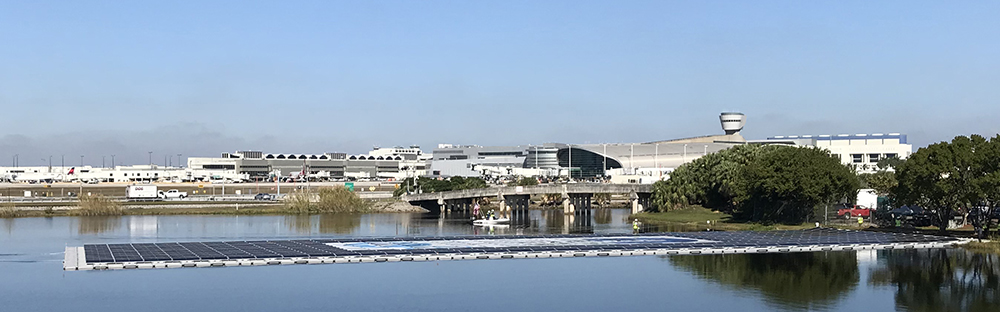
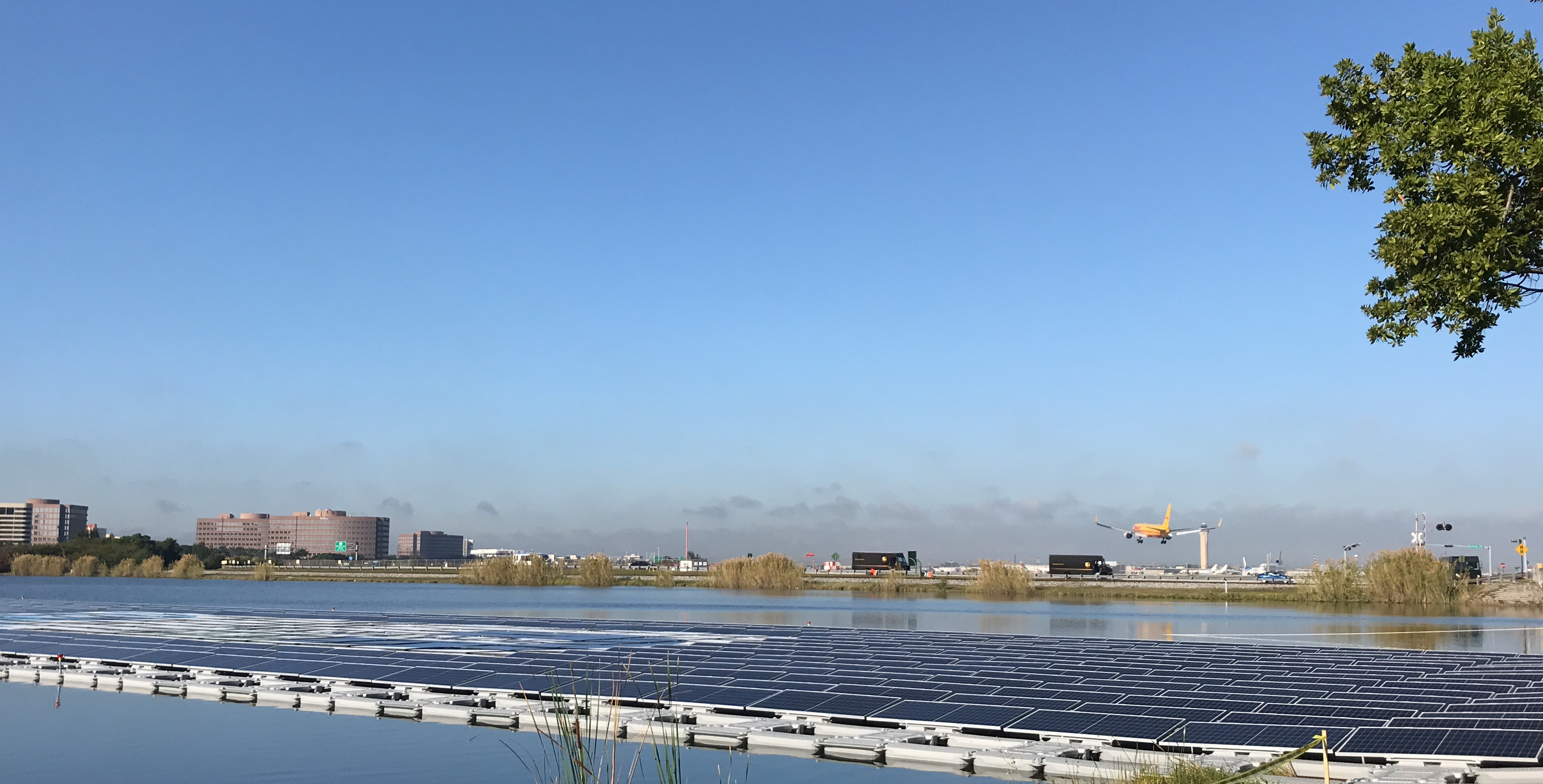
The millions of passengers who land at MIA every year are now greeted from below by a Florida landmark that showcases Miami-Dade County’s commitment to innovation and clean energy. In January 2020, Florida Power & Light Company and Miami-Dade County launched a half-acre, 402-panel floating solar installation into the waters of the Blue Lagoon adjacent to the airport. The partnership between FPL and Miami-Dade County is the largest floating solar array in the southeastern U.S. and the first ever at an airport.
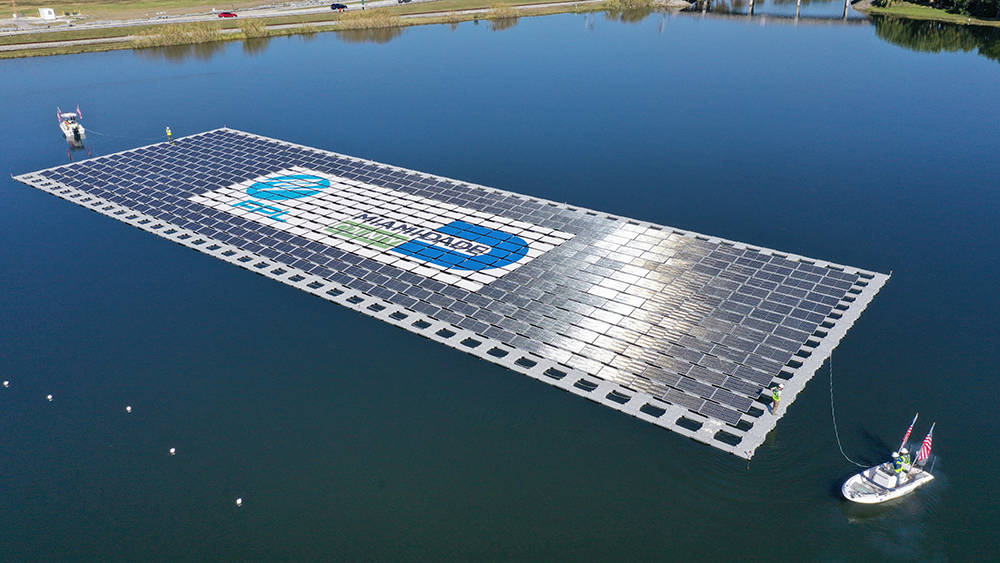
Photo courtesy Florida Power & Light
Visible from planes flying overhead as well as to drivers along the 836 West/Dolphin Expressway, the solar array generates 160 kilowatts of power and prevents 165 tons of carbon dioxide emissions annually. The array will double as a test bed for cutting-edge solar research, particularly the performance of solar panels on water.
• Bring an empty reusable water bottle to fill up post-security at our water refill stations.
• Charge all carry-on devices before arriving at the airport.
• Pack lightly to help reduce the weight on the plane.
• Use an e-ticket to board.
• Use public transportation.
• If you have an electric vehicle, use our charging stations.
Project Title: New Baggage Handling System
Project Timeline:
Project Summary:
Project Benefits:
MIA-CBIS LEED Gold Certified Information
MIA-CBIS LEED Gold Certified Score Card
Miami International Airport (MIA) Achieves Key Sustainability Milestone with Progress Toward Level 2 Airport Carbon Accreditation (ACA)
MIAMI, FL — July 1, 2026 — As part of its ongoing commitment to environmental stewardship and sustainable aviation, Miami International Airport (MIA) has successfully completed a third-party verification of its calendar year 2025 greenhouse gas (GHG) emissions. This critical milestone advances MIA toward achieving Level 2 Certification under the internationally recognized Airport Carbon Accreditation (ACA) program.
Upon final certification, MIA will become only the 16th airport nationwide and the second in Florida to earn this distinction. The ACA program provides a rigorous, multi-level framework that challenges airports to meet progressively stringent carbon management standards.
In 2023, MIA's total Scope 1 and Scope 2 leveled at 102,789 metric tons of carbon dioxide equivalent (CO2e), representing a carbon intensity efficiency of 2.03 kilograms of CO2e per passenger.
In 2025, MIA’s total Scope 1 and Scope 2 emissions leveled at 98,275 metric tons of CO2e, representing a carbon intensity efficiency of 1.78 kilograms of CO2e per passenger.
To maintain this momentum, MIA has established aggressive and measurable per-passenger carbon intensity reduction targets relative to its verified 2023 base year emissions:
For more information about airport accreditation certification initiatives, please visit https://www.airportcarbonaccreditation.org/